STUDIO TECNICO NAVALE dott. ing. PAOLO PONSICCHI
INGEGNERE NAVALE E MECCANICO
NAVAL ARCHITECT AND MARINE ENGINEER
M/Y Penelope - Revisione MM/PP MM/EE overhaul
Eurocraft refitting
LOA = 47.50 m
Bmax = 8.60 m
DISW = 484 t
Materiale scafo: acciaio
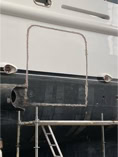
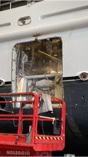
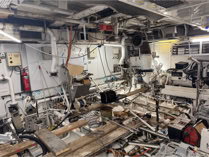
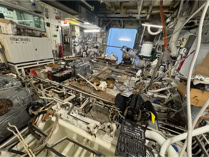
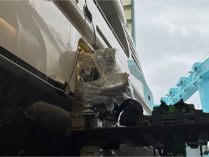
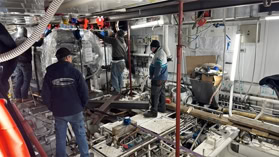
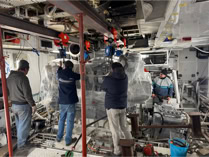
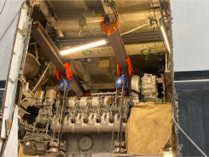
Data la necessità di revisionare totalmente i motori principali e gli invertitori (MTU 12V4000 M70 e ZF 7540), non esistendo cofani in coperta, si è optato per operare attraverso il fasciame del fianco. Abbiamo individuato nel lato sinistro della sala macchine una zona del fianco fra due ossature rinforzate che consentiva l’effettuazione di un taglio rettangolare sufficiente a far passare i motori dopo averli ruotati perpendicolarmente all’asse longitudinale della nave. Naturalmente è stato necessario smontare pressoché totalmente la sala macchine.
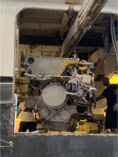
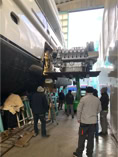
La fase di sbarco dei motori non presentava particolari difficoltà in quanto questi erano stati parzialmente smontati ed è quindi stato possibile inserire il braccio di una gru, sollevarli ed estrarli.
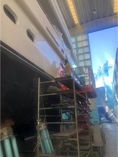
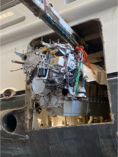
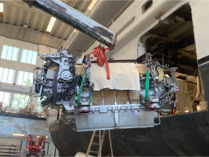
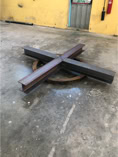
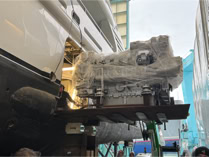
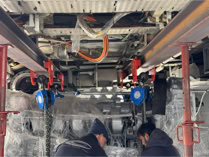
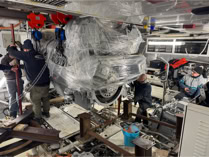
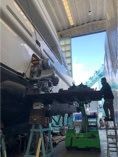
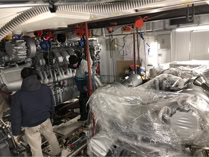
Più complessa è stata la fase di imbarco dei motori, completamente montati. Questi sono stati portati al livello dell’apertura tramite una piattaforma esterna e posizionati su carrelli per poter essere spostati all’interno della sala macchine. Qui è stata predisposta una ralla, in corrispondenza dei basamenti del motore di sinistra, sulla quale è stato posato il motore di dritta; tramite la ralla è stato fatto ruotare in senso prua-poppa. Sono state altresì posizionate, previo calcolo sulla portata del sistema, due travi HEA trasversali, saldate alle travi rinforzate del ponte coperta, dotate di quattro carrelli ai quali è stato appeso il motore. Questo è stato quindi traslato sui suoi basamenti di dritta e calato in posizione.
Il motore di sinistra è stato poi appoggiato sulla piattaforma esterna, portato sulla ralla, ruotato e alzato tramite i carrelli e le travi trasversali per togliere la ralla. Fatto ciò è stato calato in posizione sui suoi basamenti.
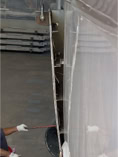
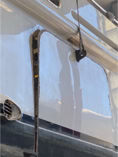
Si è poi proceduto al ripristino del fasciame del fianco, risaldando la parte precedentemente asportata, e all’allestimento della sala macchine.
LOA = 47.50 m
Bmax = 8.60 m
DISW = 484 t
Hull material: steel
Given the need to completely overhaul the main engines and inverters (MTU 12V4000 M70 and ZF 7540), since there were no covers on deck, we opted to work through the side planking. We identified a section of the side between two reinforced frameworks on the port side of the engine room that allowed us to make a rectangular cut large enough to accommodate the engines after rotating them perpendicular to the ship's longitudinal axis. Naturally, the engine room had to be almost completely dismantled.
Disembark the engines was not particularly difficult as they had been partially dismantled, allowing us to insert a crane arm, lift them, and extract them.
The loading of the fully assembled engines was more complex. They were raised to the level of the opening via an external platform and positioned on trolleys to be moved within the engine room. Here, a fifth wheel was positioned in correspondence with the port engine bases, on which the starboard engine was placed; using the fifth wheel, it was rotated from bow to stern. Following system load-bearing calculations, two transverse HEA beams were also positioned, welded to the reinforced beams of the deck, equipped with four trolleys from which the engine was suspended. The engine was then moved onto its starboard bases and lowered into position.
The port engine was then placed on the external platform, raised onto the fifth wheel, rotated, and lifted using the trolleys and transverse beams to remove the fifth wheel. Once this was done, the engine was lowered into position on its bases.
We then proceeded to restore the side planking, re-welding the previously removed part, and to set up the engine room.